
Beat the Belly: Why Stopping Late-Night Eating Is Your Greatest Weapon Against Abdominal Fat
Belly fat, particularly visceral adipose tissue, is one of the most health-threatening forms of body fat, wrapping around internal organs and producing inflammatory compounds that raise the risk of type 2 diabetes, cardiovascular disease, and metabolic syndrome (Spritzler, 2025). While diet and exercise are widely recognized fat-loss tools, meal timing, specifically late-night eating, remains critically underemphasized. Emerging research shows that when we eat it may be nearly as important as what we eat (Capers et al., 2015; Sato et al., 2020).
Understanding Belly Fat
Visceral fat accumulates deep within the abdominal cavity, surrounding vital organs, and is metabolically active in a harmful sense: it releases free fatty acids, inflammatory cytokines, and hormones that impair insulin sensitivity and elevate cardiovascular risk (Yamazaki et al., 2022). Fat accumulation is fundamentally driven by a caloric surplus, but its location and rate are significantly influenced by hormonal environment, sleep quality, stress, and meal timing (Capers et al., 2015). When insulin levels are chronically elevated, as occurs with frequent or late eating, the body spends more time in fat-storage mode and less in fat-burning mode (Spritzler, 2025).
The Science of Late-Night Eating
Circadian Disruption.
The body's master clock governs digestion, hormone secretion, insulin sensitivity, and fat metabolism (Froy, 2010). At night, insulin sensitivity drops, gastric motility slows, and melatonin rises, all signals for rest, not digestion (Scheer et al., 2009). Eating after approximately 8:00 p.m. forces the digestive and endocrine systems to operate against this clock, resulting in heightened fat storage, impaired glucose tolerance, and reduced overnight fat oxidation (OnePeak Medical, 2024).
Reduced Fat Burning During Sleep.
A Vanderbilt University study published in PLOS Biology demonstrated that late-night eating significantly reduced fat burned during sleep, even when total caloric intake was identical to earlier eaters, confirming that meal timing, independent of calories, alters nocturnal fat-burning capacity (Sato et al., 2020).
Insulin Spikes and Fat Storage.
Because cells are less insulin-sensitive at night, elevated nighttime glucose is more readily converted to triglycerides and stored in abdominal adipose tissue (OnePeak Medical, 2024). Research comparing participants eating at 10 p.m. versus 6 p.m. found that late eaters had higher postprandial glucose, slower fat breakdown, and elevated cortisol, a stress hormone that directly drives abdominal fat deposition (OnePeak Medical, 2024).
Hormonal Disruption.
Late-night eating disrupts ghrelin (hunger hormone) and leptin (satiety hormone), creating increased appetite the following day and perpetuating a cycle of overconsumption (Capers et al., 2015; Spritzler, 2025). A Harvard-cited study in Current Biology found that late eating increased hunger, suppressed leptin, elevated ghrelin, and altered adipose tissue gene expression in favor of fat storage (Vujovic et al., 2022).
Higher Caloric Intake.
Behaviorally, late-night eaters consistently consume more total daily calories, with those eating between 11:00 p.m. and 5:00 a.m. consuming approximately 500 more calories per day than daytime eaters (Healthline, 2018). Even a small shift in snack timing matters; subjects eating a morning snack burned approximately 6 grams more fat daily than those eating the same snack at night, and the late-snack group saw a 9% rise in LDL cholesterol within two weeks (Greger, 2022).
The Role of Intermittent Fasting
Intermittent fasting (IF), cycling between designated eating windows and fasting periods, is one of the most evidence-supported strategies for reversing the metabolic damage of late-night eating habits (Spritzler, 2025). By extending the overnight fast (e.g., 12–16 hours), insulin levels drop to baseline, enabling the body to shift from glucose metabolism to fat oxidation (Arciero et al., 2023).
Time-restricted eating (TRE), limiting the daily eating window to 8–10 hours, aligns food intake with peak metabolic activity and has been shown to reduce visceral fat, improve insulin sensitivity, and regulate hunger hormones (Panda, 2019; Arciero et al., 2023). Dr. Satchin Panda notes that melatonin, which rises in early evening, signals pancreatic beta cells to reduce insulin secretion, meaning eating while melatonin is elevated impairs glucose disposal and promotes fat storage (Panda, 2019).
A practical and sustainable recommendation:
Finish the last meal at least 2–3 hours before bedtime and aim for a minimum 12-hour overnight fast. Eat dinner before 7:45pm, sleep at 10 pm if you wake up at 5am that 7hours of sleep.
If You Must Eat at Night
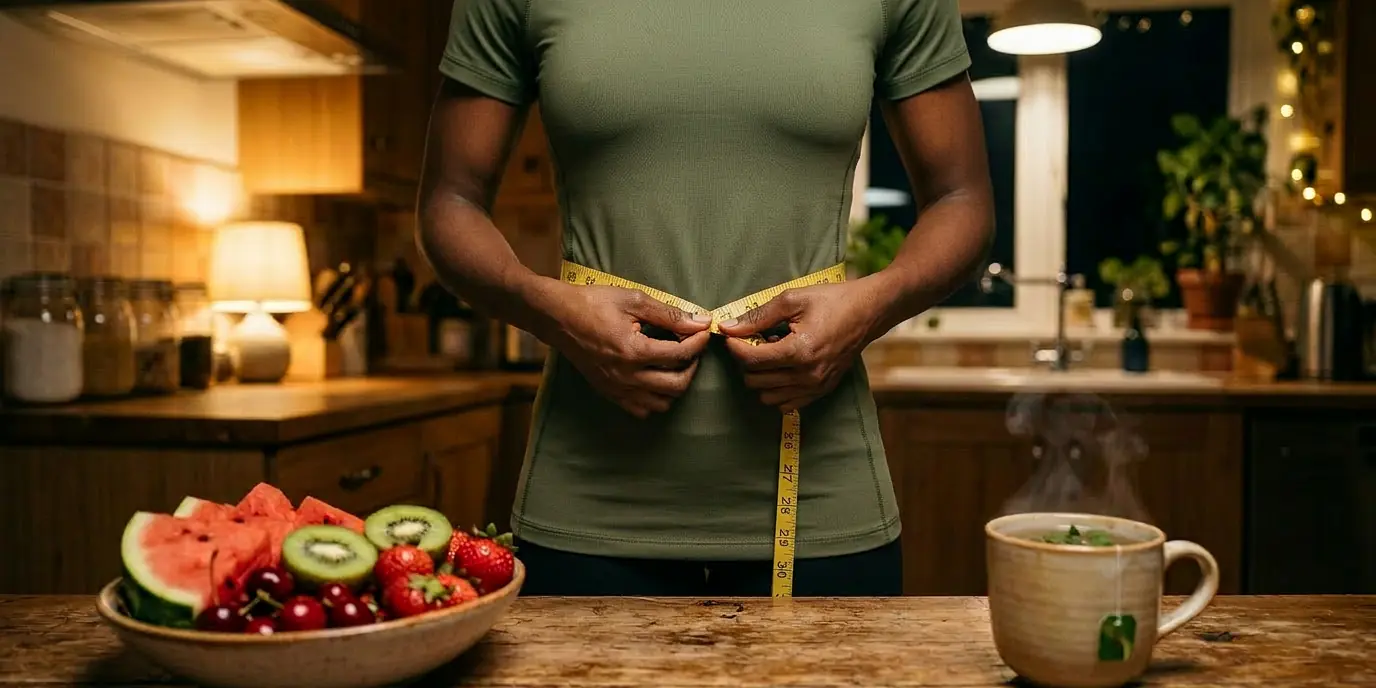
A warm, unsweetened herbal tea is the most metabolically benign option, virtually calorie-free and unlikely to trigger insulin secretion (Fitterfly, 2024; Tua Saúde, 2023). If food is truly needed, the following low-calorie fruits are the best choices.
Best Fruits for Nighttime Consumption During Weight Loss (Approx. Calories per 100g )
Watermelon is about 30 kcal, 90% water and highly filling at very low calories. It’s hydrating and reduces nighttime hunger.
Strawberries are about 32 kcal with Low sugar, high in potassium, and Vitamin C, and have a minimal insulin response.
Papaya is about 43 kcal, it contains papain, improves digestion, reduces bloating, and aids gut motility overnight.
Apple is about 52 kcal, it’s high in soluble fiber, curbs sweet cravings, with pectin that supports gut microbiome.
Kiwi is about 60 kcal with Actinidin enzyme; contains melatonin and serotonin and has been clinically shown to improve sleep onset and quality.
Cherries are 63 kcal, a Natural source of melatonin, and promote deeper and restorative sleep.
Caloric values adapted from Paras Hospitals (2025), Cellublue (2026), and Bolt Pharmacy (2026).
Additional Evidence-Based Strategies
Increase soluble fiber: from oats, flaxseeds, legumes, and vegetables
Prioritize dietary protein: higher protein intake is consistently associated with lower abdominal fat (Spritzler, 2025)
Reduce refined carbs and added sugar: which spike insulin and drive visceral fat storage (Spritzler, 2025)
Exercise: combined aerobic and resistance training produces the greatest reduction in visceral adiposity (Dâmaso et al., 2014, as cited in Spritzler, 2025)
Manage chronic stress: elevated cortisol preferentially deposits fat abdominally; yoga, meditation, and deep breathing are evidence-supported interventions (Kühnel et al., 2023, as cited in Spritzler, 2025)
Prioritize sleep: sleeping fewer than six hours per night is significantly associated with weight gain over time (Patel & Hu, 2006, as cited in Spritzler, 2025)
The hours between dinner and sleep are where many people unknowingly win or lose the battle against belly fat. Closing the kitchen 2–3 hours before bed may be the single most powerful step toward a leaner, healthier midsection.
References
Arciero, P. J., Arciero, K. M., Strand, A., Ives, S. J., & Arciero, A. (2023). Intermittent fasting and protein pacing are superior to caloric restriction for weight and visceral fat loss. Nutrients, 15(4), 1000. https://pmc.ncbi.nlm.nih.gov/articles/PMC10107279/
Bolt Pharmacy. (2026, March 2). Best fruits for calorie deficit: Low-calorie options for weight loss. https://www.boltpharmacy.co.uk/guide/best-fruits-for-calorie-deficit
Capers, P. L., Fobian, A. D., Kaiser, K. A., Borah, R., & Allison, D. B. (2015). A systematic review and meta-analysis of randomized controlled trials of the impact of sleep duration on adiposity and components of energy balance. Obesity Reviews, 16(9), 771–782. https://doi.org/10.1111/obr.12296
Cellublue. (2026, March 31). Best fruits to eat at night for weight loss. https://www.cellublue.com/blog/en/which-fruit-to-eat-in-the-evening-to-lose-weight/
Dâmaso, A. R., da Silveira Campos, R. M., Caranti, D. A., de Piano, A., Fisberg, M., Foschini, D., de Lima Sanches, P., Tock, L., Lederman, H. M., Tufik, S., & de Mello, M. T. (2014). Aerobic plus resistance training was more effective in improving the visceral adiposity, metabolic profile and inflammatory markers than aerobic training in obese adolescents. Journal of Sports Sciences, 32(15), 1435–1445. https://pubmed.ncbi.nlm.nih.gov/24730354/
Fitterfly. (2024, September 26). 5 best night time drinks to lose weight. https://www.fitterfly.com/blog/best-night-time-drink-to-lose-weight/
Froy, O. (2010). Metabolism and circadian rhythms — implications for obesity. Endocrine Reviews, 31(1), 1–24. https://doi.org/10.1210/er.2009-0014
Greger, M. (2022, February 7). The metabolic harms of night shifts and irregular meals [Video]. NutritionFacts.org. https://nutritionfacts.org/video/the-metabolic-harms-of-night-shifts-and-irregular-meals/
Hairston, K. G., Vitolins, M. Z., Norris, J. M., Anderson, A. M., Hanley, A. J., & Wagenknecht, L. E. (2011). Lifestyle factors and 5-year abdominal fat accumulation in a minority cohort: The IRAS Family Study. Obesity, 20(2), 421–427. https://pmc.ncbi.nlm.nih.gov/articles/PMC3856431/
Hall, K. D., Ayuketah, A., Brychta, R., Cai, H., Cassimatis, T., Chen, K. Y., Chung, S. T., Costa, E., Courville, A., Darcey, V., Fletcher, L. A., Forde, C. G., Gharib, A. M., Guo, J., Howard, R., Joseph, P. V., McGehee, S., Ouwerkerk, R., Rozga, M., … Zhou, M. (2021). Ultra-processed diets cause excess calorie intake and weight gain: An inpatient randomized controlled trial of ad libitum food intake. Cell Metabolism, 30(1), 67–77. https://pmc.ncbi.nlm.nih.gov/articles/PMC7946062/
Healthline. (2018, October 1). Does eating late at night cause weight gain? https://www.healthline.com/nutrition/eating-at-night
Healthline. (2023, February 21). The 9 best foods and drinks to have before bed. https://www.healthline.com/nutrition/9-foods-to-help-you-sleep
Kühnel, A., Teckentrup, V., Nenadić, I., & Kroemer, N. B. (2023). Stress-induced brain responses are associated with BMI in women. Communications Biology, 6, Article 1073. https://www.nature.com/articles/s42003-023-05396-8
McKeown, N. M., Troy, L. M., Jacques, P. F., Hoffmann, U., O'Donnell, C. J., & Fox, C. S. (2010). Whole- and refined-grain intakes are differentially associated with abdominal visceral and subcutaneous adiposity in healthy adults: The Framingham Heart Study. American Journal of Clinical Nutrition, 92(5), 1165–1171. https://pmc.ncbi.nlm.nih.gov/articles/PMC2954448/
Moon, J., & Koh, G. (2020). Clinical evidence and mechanisms of high-protein diet-induced weight loss. Journal of Obesity & Metabolic Syndrome, 29(3), 166–173. https://pmc.ncbi.nlm.nih.gov/articles/PMC7539343/
OnePeak Medical. (2024, May 14). The connection between late-night eating and belly fat. https://www.onepeakmedical.com/brilliant-burnout-the-connection-between-late-night-eating-and-belly-fat/
Panda, S. (2019, July 11). Time-restricted eating and the effect of late night eating [Podcast episode]. Found My Fitness. https://www.foundmyfitness.com/episodes/time-restricted-eating-effect-of-late-night-eating
Paras Hospitals. (2025, December 25). Best low calorie fruits to eat daily for weight loss. https://www.parashospitals.com/blogs/best-low-calorie-fruits-for-weight-loss
Patel, S. R., & Hu, F. B. (2006). Short sleep duration and weight gain: A systematic review. Obesity, 16(3), 643–653. https://pmc.ncbi.nlm.nih.gov/articles/PMC3496783/
Sato, M., Nakamura, K., Ogata, H., Miyashita, A., Nagasaka, S., Omi, N., Tanaka, K., & Tokuyama, K. (2020). Acute effect of late eating on sleep, eating behavior, and autonomic responses to eating. PLOS Biology. Vanderbilt University Medical Center. https://medschool.vanderbilt.edu/basic-sciences/2020/04/03/late-night-meals-may-reduce-how-much-fat-your-body-burns-at-night/
Scheer, F. A. J. L., Hilton, M. F., Mantzoros, C. S., & Shea, S. A. (2009). Adverse metabolic and cardiovascular consequences of circadian misalignment. Proceedings of the National Academy of Sciences, 106(11), 4453–4458. https://doi.org/10.1073/pnas.0808180106
Spritzler, F. (2025, June 17). 18 effective tips to lose belly fat (backed by science). Healthline. https://www.healthline.com/nutrition/20-tips-to-lose-belly-fat
The Good Bug. (2025, August 12). Best fruits to eat at night for weight loss. https://thegoodbug.com/blogs/news/best-fruits-night-weight-loss
Tua Saúde. (2023, January 4). Slimming tea: 9 tea recipes for a flat belly. https://www.tuasaude.com/en/slimming-tea/
Vujovic, N., Piron, M. J., Qian, J., Chellappa, S. L., Nedeltcheva, A., Barr, D., Heng, S. W., Kerlin, K., Srivastav, S., Wang, W., Shoji Bhatt, D., Guo, M., Scheer, F. A. J. L., & Czeisler, C. A. (2022). Late eating is associated with obesity, impaired fat metabolism and daytime sleepiness in adults with overweight/obesity. Cell Metabolism, 34(10), 1486–1498. https://www.foundmyfitness.com/stories/ritdkh/eating_late_at_night_promotes_weight_gain
WebMD. (n.d.). Diet truth or myth: Eating at night causes weight gain. https://www.webmd.com/diet/features/diet-truth-myth-eating-night-causes-weight-gain
Yamazaki, H., Tauchi, S., Nishimoto, S., Fukuhara, S., Kanemitsu, T., & Kato, S. (2022). Fat distribution patterns and future type 2 diabetes. Diabetes, 71(9), 1937–1943. https://diabetesjournals.org/diabetes/article/71/9/1937/147108