
Eat Like Japan: Food Habits That Unlock Wellness
Japan consistently ranks among the world's healthiest and longest-lived nations, and researchers trace much of this to its traditional food culture (Shubrook & Torrens, 2025; Shirai & Tsushita, 2024). These are not complicated diet regimes, they are centuries-old daily habits: small portions, deliberate chewing, chopstick use, vegetable abundance, and a balanced meal philosophy that works quietly but powerfully in the background of every meal.
Hara Hachi Bu: Stop at 80%
The Confucian-inspired principle Hara Hachi Bu, "eat until you are 80% full", is perhaps the most celebrated Japanese eating habit (Times of India, 2024). Okinawans recite this phrase before meals as a mindful reminder to stop before they feel stuffed. It takes roughly 20 minutes for the brain to receive fullness signals from the gut, and stopping at 80% honors that delay (Times of India, 2025a). The result: Japan's overall obesity rate sits at just 3–4%, compared to 41.9% in the United States (Hennes, 2024).
The benefits are wide-ranging: better digestion, lower inflammation, improved metabolism, and a reduced risk of cancer, stroke, and heart disease (Times of India, 2024; Hennes, 2024; Food Bible, 2026).
Chew More, Eat Less
Digestion begins in the mouth. Thorough chewing, ideally 20–30 times per bite, breaks food into smaller particles, activates digestive enzymes in saliva, and gives the body enough time to signal satiety before overeating occurs (Cedar Tree Dental, 2024; Institute of Holistic Nutrition, 2025). Poor chewing leads to indigestion, bloating, poor nutrient absorption, and constipation (Burton Health, 2024). Simply slowing down at the chewing stage can meaningfully reduce how much a person eats in a sitting.
Chopsticks: A Hidden Health Tool
Chopsticks pick up smaller amounts per bite than a fork or spoon, naturally slowing the eating pace and encouraging mindfulness at the table (Thinking Nutrition, 2015; Times of India, 2025a). Research found that eating rice with chopsticks produces a glycaemic index (GI) of 68, compared to 81 when eaten with a spoon, a meaningful reduction in post-meal blood sugar spikes that protects against insulin resistance and type 2 diabetes (Thinking Nutrition, 2015; Sun et al., 2015).
Vegetables: Variety Is the Point
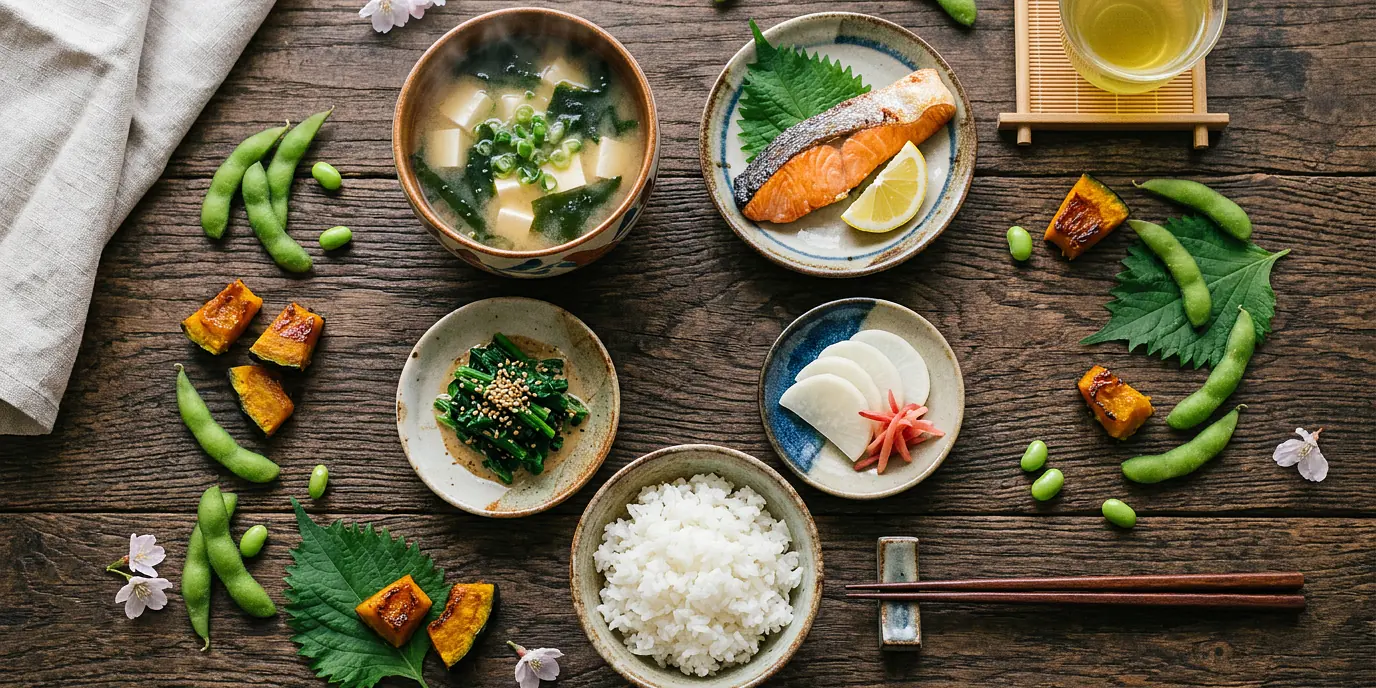
Japanese cuisine incorporates vegetables in multiple forms; raw, steamed, pickled, sautéed, and fermented, preserving different nutrients and feeding different gut microbiome populations (Kobe Steak House, 2024). The diet includes fiber-rich daikon, antioxidant-packed kabocha, vitamin-dense shiso, and seaweed rich in iodine and calcium (YiEM International, 2021; Shubrook & Torrens, 2025). Fermented foods like miso and natto add probiotics that support gut health, immunity, and metabolism (Plenus Co., Ltd., n.d.; Himizu Restaurant, 2025).
Balanced by Design: Ichiju Sansai
The traditional meal structure Ichiju Sansai ("one soup, three sides") naturally engineers nutritional balance: a bowl of miso soup, one protein, two vegetable sides, and rice (Plenus Co., Ltd., n.d.). No calorie counting required, the structure itself limits saturated fat and processed food while maximizing fiber, micronutrients, and probiotics (Shubrook & Torrens, 2025; Healthline, 2019). A large BMJ study found that adherence to this dietary pattern significantly reduced early death from heart disease and stroke (Shubrook & Torrens, 2025).
The Bottom Line- How to Apply the Habits
Hara Hachi Bu: Stop eating when 80% full (Times of India, 2024)
Slow chewing: Chew each bite 20–30 times (Cedar Tree Dental, 2024)
Chopsticks: Use them to slow pace and lower GI response (Sun et al., 2015)
More vegetables: Aim for 5+ servings in varied preparations (Kobe Steak House, 2024)
Balanced plate: One soup + one protein + two vegetable sides (Plenus Co., Ltd., n.d.)
Hara Hachi Bu: Stop eating when 80% full (Times of India, 2024)
Slow chewing: Chew each bite 20–30 times (Cedar Tree Dental, 2024)
Chopsticks: Use them to slow pace and lower GI response (Sun et al., 2015)
More vegetables: Aim for 5+ servings in varied preparations (Kobe Steak House, 2024)
Balanced plate: One soup + one protein + two vegetable sides (Plenus Co., Ltd., n.d.)
These practices are not about restriction, they are about building a relationship with food rooted in moderation, variety, and attention. That, more than any superfood or supplement, is what sustains one of the world's healthiest populations.
References
Burton Health. (2024, December 13). The importance of chewing food thoroughly for better digestion. https://www.burtonhealth.com.au/blog/the-importance-of-chewing-food-thoroughly-for-better-digestion
Cedar Tree Dental. (2024, June 10). The benefits of chewing food thoroughly. https://cedartreedentalvictoria.com/the-benefits-of-chewing-food-thoroughly/
Food Bible. (2026, February 8). Blue Zone ethos of 'Hara Hachi Bu' could help you live longer. https://www.foodbible.com/health/diet/hara-hachi-bu-blue-zone-okiwana-eating-practice-231834-20260130
Healthline. (2019, September 18). The Japanese diet: Benefits, food list, and meal plan. https://www.healthline.com/nutrition/japanese-diet
Hennes, M. (2024, August 13). Hara hachi bu: Experts explain the Japanese eating philosophy. Women's Health Magazine. https://www.womenshealthmag.com/health/a61663287/hara-hachi-bu/
Himizu Restaurant. (2025, January 25). Why Japanese food is the secret to a healthier you. https://www.himizurestaurant.com/blog/why-japanese-food-is-the-secret-to-a-healthier-you
Institute of Holistic Nutrition. (2025). Power of proper chewing: Transforming metabolism through effective food mastication. https://instituteofholisticnutrition.com/power-of-proper-chewing-transforming-metabolism-through-effective-food-mastication/
Kobe Steak House. (2024, August 26). The Japanese food pyramid: The staples of a balanced diet. https://kobesteakhouse.com/the-japanese-food-pyramid/
Plenus Co., Ltd. (n.d.). Why Japanese food is good for health. Rice and Health. https://www.plenus.co.jp/kome-academy/en/kome_library/health/reason.html
Shirai, T., & Tsushita, K. (2024). Lifestyle medicine and Japan's longevity miracle. American Journal of Lifestyle Medicine, 18(4), 598–607. https://doi.org/10.1177/15598276241234012
Shubrook, N., & Torrens, K. (2025). Why is the Japanese diet so healthy? BBC Good Food. https://www.bbcgoodfood.com/health/healthy-food-guides/why-japanese-diet-so-healthy
Sun, L., Ranawana, D. V., Tan, W. J. K., Quek, Y. C. R., & Henry, C. J. (2015). The impact of eating methods on eating rate and glycemic response in healthy adults. Physiology & Behavior, 139, 505–510. https://doi.org/10.1016/j.physbeh.2014.12.014
Thinking Nutrition. (2015, February 17). How using chopsticks can be good for your health. https://www.thinkingnutrition.com.au/using-chopsticks-good-for-health/
Times of India. (2024, November 26). This simple Japanese eating habit can be the ultimate secret to longevity. https://timesofindia.indiatimes.com/life-style/food-news/this-simple-japanese-eating-habit-can-be-the-ultimate-secret-to-longevity
Times of India. (2025a). Hara hachi bu: The Okinawan secret to longevity and better metabolism. https://timesofindia.indiatimes.com/life-style/health-fitness/diet/hara-hachi-bu-the-okinawan-secret-to-longevity-and-better-metabolism
YiEM International. (2021, May 24). 4 popular Japanese vegetables you must try for a healthy diet. https://yiem.co.jp/en/4-popular-japanese-vegetables-you-must-try-for-a-healthy-diet/