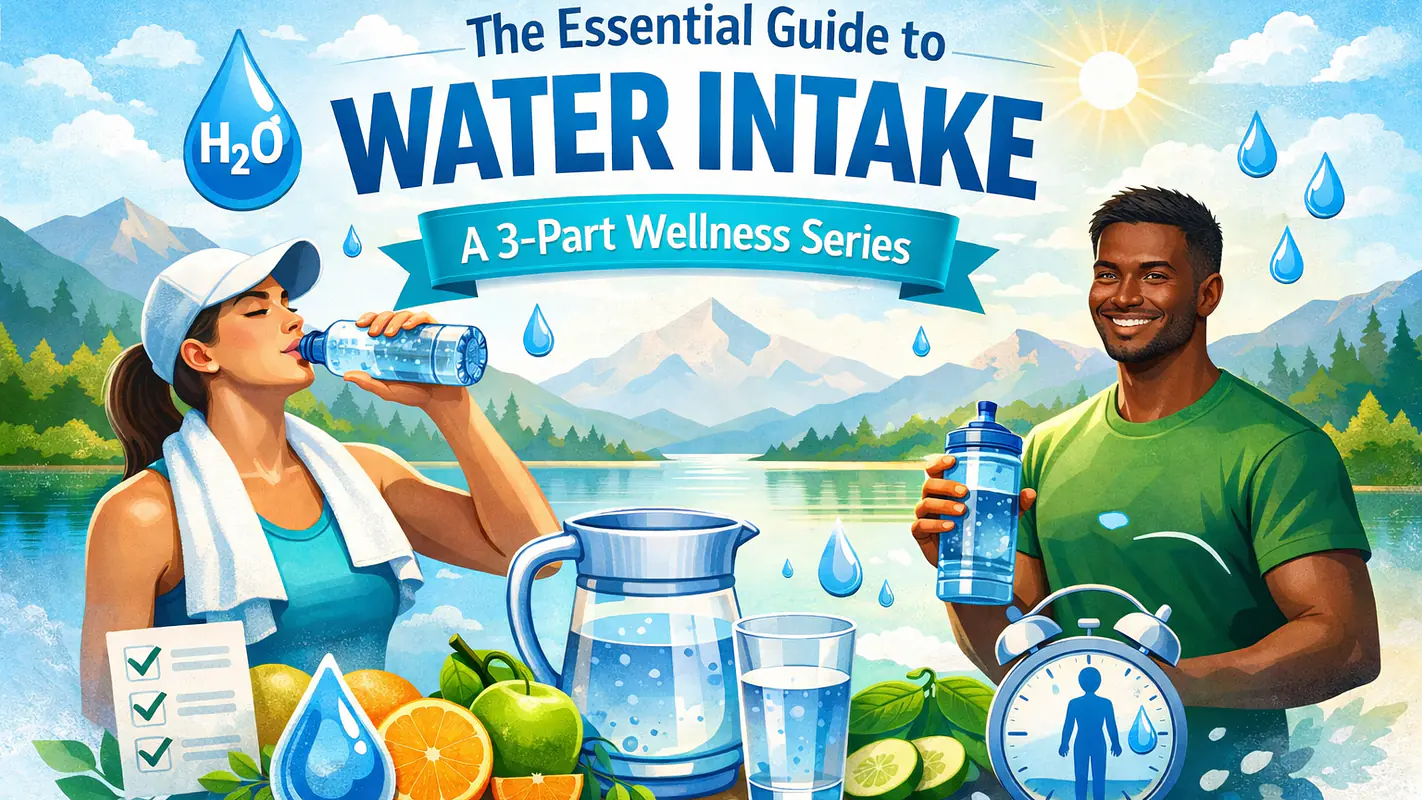
The Essential Guide to Water Intake- A 3-Part Wellness Series
Part 1: Hydrate with Intention: The Power of Water and the Words You Speak Over It
Series Introduction
Water is the most fundamental substance on earth, and inside the human body. It makes up about 60% of who we are, touches every organ, and is involved in virtually every biological process that keeps us alive. Yet despite its central importance, water is the most underappreciated part of most people's wellness routines. We track our calories, count our steps, and monitor our sleep, but we rarely think deeply about how we hydrate, what we drink, or the intention we bring to it.[1]
This three-part series goes beyond the basics. It explores not just how much water to drink and why it matters, but also the science and spirituality of how we drink, including the transformative practice of speaking good words and blessings over your water. It examines the different types of water available today, from ancient spring sources to cutting-edge hydrogen water, and gives special attention to the unique hydration demands faced by people living in Africa's hot and demanding climate.
Whether you are just beginning your wellness journey or looking to deepen a practice you already have, these articles will give you the knowledge, inspiration, and practical tools to turn every sip into an act of self-care.
Part 1: The Foundation — Why Water Is Your Most Powerful Wellness Tool
Introduction
You can go weeks without food. You can survive days without sleep. But without water, the human body begins to fail within hours. Water is not a supplement, a trend, or a wellness hack, it is the very foundation of life. Yet chronic dehydration is one of the most widespread and overlooked health problems in the world today, with millions of people walking through their days fatigued, foggy, and unwell, not because of any disease, but simply because they are not drinking enough water. [2][3]
This first article lays the groundwork. It answers the questions most people think they already know the answers to and often get wrong: How much water do you really need? What does water actually do inside the body? What happens when you don't get enough? The answers may surprise you.
Why Water Matters So Much
Every system in the body depends on water. It delivers oxygen through the bloodstream, cushions joints, flushes toxins through the kidneys, regulates body temperature, and supports digestion. Even mild dehydration, losing as little as 1–2% of body water, can impair concentration, trigger headaches, and cause fatigue.[4][3][1]
A major 2024 analysis published in JAMA Network Open, reviewing 18 randomized controlled trials, confirmed that adequate water intake helps prevent kidney stones, supports weight management, reduces migraine frequency, and lowers the risk of urinary tract infections. Drinking enough water is one of the simplest yet most powerful things you can do for your health.[6][6]
How Much Should You Drink?
There is no one-size-fits-all number. The U.S. National Academies recommends about 3.7 liters daily for men and 2.7 liters for women from all sources, including food. Harvard Health suggests that four to six cups of plain water per day is a reasonable target for most healthy adults, since about 20% of daily fluid comes from food. [7][8][9]
Your needs increase in hot climates, during exercise, and when ill. A practical rule: drink consistently throughout the day and monitor your urine; pale and clear means you are well hydrated; dark yellow means drink more.[10]
Water Intake for Those Living in Africa
Africa's tropical and sub-tropical climates place unique demands on hydration. In countries like Nigeria, where temperatures can reach 38°C (100°F), and humidity ranges from 30% to 80%, the body loses fluid through sweat far more rapidly than in temperate regions. The standard "8 glasses a day" rule, designed for cooler climates, is often insufficient for people living and working across much of the continent.[11][12]
The World Health Organization advises drinking at least 2–3 litres of water per day, and recommends consuming about 1 cup of water every hour during hot weather. For individuals performing physical work or exercising outdoors in the African heat, fluid needs can rise to 4–6 litres per day, and even higher (up to 8–10 litres) for those doing heavy manual labour. The CDC recommends drinking one cup (250 ml) of water every 15–20 minutes when sweating heavily.[
13][14][10]
Nigerian medical experts advise the following for staying hydrated in hot weather:[15][11]
- Drink plenty of cool water throughout the day; do not wait until thirsty.
- Avoid being outdoors during midday when the sun is at its peak.
- Wear light, loose-fitting clothing to help the body regulate temperature.
- Take frequent breaks in cool or shaded areas during outdoor work.
- Replenish electrolytes lost through sweating using coconut water, oral rehydration salts, or electrolyte-rich beverages.[11]
- Eat locally available water-rich foods such as watermelon, cucumber, oranges, tomatoes, and spinach.
- Keep water in a spray bottle for refreshing spritzers.[15]
Mild to moderate dehydration typically presents these symptoms:[16][17]
- Feeling thirsty, with a dry or sticky mouth
- Headache and fatigue
- Dizziness or lightheadedness
- Dark yellow urine (well-hydrated urine is pale and clear)
- Urinating less frequently fewer than four times a day [2]
- Muscle cramps during or after exercise [18]
- More serious dehydration — which requires prompt medical attention — includes rapid heartbeat, confusion, inability to urinate for more than eight hours, sunken eyes, or fainting.[17][18]
Hydrating Foods: Eating Your Water
About 20% of daily fluid intake comes from food rather than beverages. Cucumbers (96% water), tomatoes (95%), spinach (93%), watermelon (91%), and oranges (80–90%) are among the most powerful hydrating foods available. Incorporating them into daily meals adds hydration alongside vitamins, minerals, and fiber, making them an especially smart choice in hot climates where water loss is high.[19][20][21][9][22][23]
For African readers specifically, the key takeaway is this: the hotter and more humid your environment, the more water your body needs. What works in London or New York is not enough in Lagos, Accra, Nairobi, or Johannesburg. Aim for a minimum of 3 liters daily, adjust upward based on your activity level and heat exposure, prioritize consistent sipping over gulping large amounts at once, and eat hydrating foods too.[11][12]
Reference List
- Medical News Today — How much water should I drink each day? — medicalnewstoday.com
- UCSF News — Drinking Plenty of Water May Actually Be Good for You (2024) — ucsf.edu
- British Heart Foundation — Dehydration: signs, causes, and tips to drink more water — bhf.org.uk
- Healthline — How Much Water Should You Drink Per Day? — healthline.com
- Harvard Health — More water may equate to more health benefits (2025) — health.harvard.edu
- GoHealth Urgent Care — 10 critical dehydration signs & prevention tips — gohealthuc.com
- WebMD — How Much Water Should You Drink Every Day? — webmd.com
- NIH / PMC — Water, Hydration and Health — pmc.ncbi.nlm.nih.gov
- WebMD — Signs That You May Be Dehydrated (2024) — webmd.com
- European Commission — Food-Based Dietary Guidelines recommendations for water — knowledge4policy.ec.europa.eu
- Medical News Today — 15 benefits of drinking water and other water facts — medicalnewstoday.com
- Cleveland Clinic — Dehydration: Symptoms & Causes (2023) — my.clevelandclinic.org
- Harvard Health — How much water should I drink a day? (2023) — health.harvard.edu
- Healthline — 7 Science-Based Health Benefits of Drinking Enough Water (2023) — healthline.com
- Mayo Clinic — Dehydration – Symptoms & Causes (2025) — mayoclinic.org
- Frederick Health — 10 Tips for Staying Hydrated During the Summer Heat — frederickhealth.org
- Bupa UK — Ten water-rich foods to help you stay hydrated (2024) — bupa.co.uk
- Big Blue Water — 8 Popular Hydration Myths Debunked — bigblue.co.nz
- CDC — Heat Stress: Hydration — cdc.gov
- Healthline — 19 Water-Rich Foods That Help You Stay Hydrated (2025) — healthline.com
- NPR / Life Kit — Busting 5 common myths about water and hydration (2022) — npr.org
- Mount Sinai Health — Five Tips to Stay Hydrated in the Summer Heat (2025) — health.mountsinai.org
- GoodRx — 18 Hydrating Veggies and Fruits With High Water Content (2024) — goodrx.com
-