
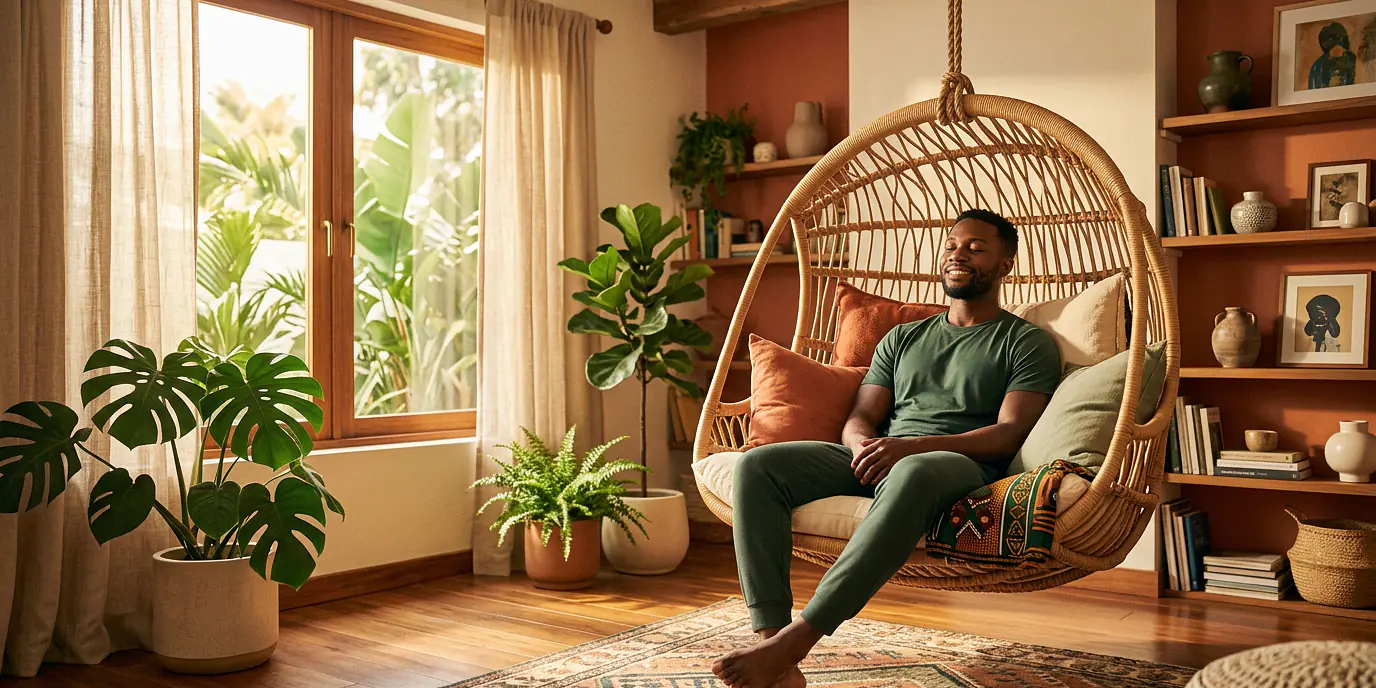
The Swing Chair: Where the Child in Me Comes Alive
There is something I do not talk about enough in my fitness sessions, the art of doing absolutely nothing, and loving every second of it.
People see me coaching reps, tracking progress, pushing limits. They assume I am always in motion, always disciplined, always on. And yes, most of the time, I am. But there is one corner of my home that knows a completely different version of me, the swing chair tucked in our family lounge, gently suspended, waiting.
The Moment I Sit Down
The moment I lower myself into that swing chair, something remarkable happens. My shoulders drop. My jaw unclenches. The noise of the day, office work, client schedules, orders, workout plans, the relentless pulse of Lagos, fades into a soft hum somewhere far behind me.
I have been reading Eckhart Tolle's The Power of Now, and his words keep echoing in my mind as I swing: "Realize deeply that the present moment is all you ever have. Make the Now the primary focus of your life" (Tolle, 1997, p. 35). That is precisely what the swing chair forces me to do, not by discipline or effort, but by grace. You cannot swing and scroll. You cannot swing and rehearse tomorrow's worries. The motion itself demands your presence. Tolle (1997) teaches that the present moment is not merely a convenient attitude to adopt, but the only place where life is actually happening. Every time I settle into that chair, I understand exactly what he means.
Research supports what Tolle describes spiritually. Creative Living (2018) confirmed that the gentle swaying of a swing chair activates the nervous system's natural relaxation response, calming physical stress and inducing a profound state of mental rest. Furthermore, Journals of IP Innovative (2025) reported that vestibular stimulation, the kind generated by gentle swinging, decreases sympathetic (fight-or-flight) activity and increases parasympathetic activity, thereby lowering blood pressure and heart rate. It is, quite literally, a physiological reset, and a portal to the Now.
The Child I Forgot I Was
Here is what I have discovered: that gentle swinging motion does not just relax the body, it unlocks something. Somewhere around the third or fourth sway, I stop being a fitness trainer with targets to meet. I become a child again.
I remember what it felt like to sit on a playground swing with no destination, no purpose, no performance goal. Just pure, uncomplicated joy in the movement itself. Tolle (1997) would recognise this instantly, he writes, "Say 'yes' to life, and see how life suddenly starts working for you rather than against you". A child on a swing has already mastered this. There is no resistance, no agenda, only the pure, joyful acceptance of the present moment that Tolle (1997) describes as the doorway to peace and aliveness.
Science validates this feeling too. Provasi et al. (2021) established that humans are hardwired to respond to rhythmic motion from before birth, the fetal environment is saturated with vestibular, somatosensory, and auditory rhythmic stimuli, and this primal neurological preference does not simply vanish when we grow up. Happiest Baby (2025) further noted that rocking and swinging motions trigger the innate calming reflex, a deep neurological response embedded in the brain, which is why even adults instinctively feel peaceful when gently rocked or swayed. The swing chair gives me that gift freely, every single time.
What Your Body Is Trying to Tell You
As a trainer, I spend a lot of time helping people understand their bodies. And here is what I know: the human body craves rhythmic, repetitive movement. Rajagopalan et al. (2017) established that the vestibular system plays a vital role in body balance and emotional well-being, and that modulating it through swinging is effective in stress relief and emotional regulation. Joshi et al. (2018) further demonstrated that vestibular stimulation directly activates the vagus nerve, increasing calming vagal signals sent to the central nervous system while producing measurable decreases in heart rate. Heloa (2025) also noted that rocking motion triggers the release of oxytocin, a hormone integral to the reduction of cortisol, the body's primary stress hormone.
Tolle (1997) speaks of accessing what he calls the "inner body", a living, pulsating field of energy beneath thought and noise, accessible only through stillness and present awareness. The swing chair, for me, is exactly that portal. "When these gaps occur," he writes, "you feel a certain stillness and peace inside you. This is the beginning of your natural state of felt oneness with Being" (Tolle, 1997, p. 49). The swing creates those gaps, every sway interrupts the mental chatter, every back-and-forth a soft reminder: you are here, not in tomorrow's to-do list.
The swing chair is not just furniture. It is therapy with a cushion.
The Case for Playing Again
Beyond physiology, there is a deeper truth that psychology has long recognised. Baotao Group (2024) suggested that repetitive movements such as swinging can reduce anxiety and promote feelings of safety. Ran et al. (2022) found that adults who engage in playful activity demonstrate higher emotional intelligence, more positive moods, and greater resilience when faced with life's stressors. Siesta Hammocks (2026) noted that sensory swings are increasingly being used in therapeutic settings to help adults manage anxiety, depression, and stress, precisely because the rhythmic motion regulates the vestibular system and produces a calming effect on the brain.
Tolle (1997) reminds us that "unease, anxiety, tension, stress, worry, all forms of fear, are caused by too much future, and not enough presence". The swing chair, with its simple, meditative sway, is an effortless antidote to that very tendency. It pulls you back, not with force, but with gentleness, into the only moment that has ever truly existed: now.
A Recommendation for the Office
Now let me speak directly to business owners, managers, and HR leaders, because this is too valuable an insight to keep confined to the home.
Consider placing a swing chair, or a small cluster of them, in your office's relaxation zone. This is not a frivolous idea. Ahead App (2025) consistently showed that thoughtfully designed wellness zones reduce stress and burnout while simultaneously boosting productivity and team cohesion. Surfy (2024) found that 55% of employees reported improved concentration after spending time in a dedicated relaxation space, and Bestar (2025) noted that one in five workers believes that having more spaces to relax away from their desks would directly improve their performance.
Beyond rest, Patio Productions (2023) noted that hanging chairs and swings improve circulation, reduce pressure points, and promote muscle relaxation through the gentle swaying motion, effects that a standard office chair simply cannot replicate. Patio Productions (2023) further reported that swinging in a hanging chair increases endorphins and measurably reduces cortisol levels, directly countering the stress that accumulates during a demanding workday. Office Rent Info (2023) linked office design that incorporates mental health–oriented features to reduced absenteeism, improved employee well-being, and stronger loyalty to the organisation.
Think of the swing chair in your break room not as a luxury, but as a productivity tool. A five-minute swing during a stressful afternoon is not wasted time, it is a full neurological reset. As Tolle (1997) reminds us, the most creative and effective work flows not from a mind cluttered with worry, but from one that has learned to inhabit the present moment. Give your team permission, and the physical space, to find that presence.
My Invitation to You
So here is my challenge to you, not a fitness challenge this time, but a humanity challenge.
Whether at home or at the office: find a swing chair. Sit in it. Let it move you.
Do not scroll your phone. Do not plan tomorrow. Do not count anything. Just swing, and let yourself remember what it felt like to be seven years old with nowhere to be and nothing to prove. Tolle (1997) describes exactly this state: "Just be, and enjoy being. If you are present, there is never any need for you to wait for anything". That version of you, unhurried, present, free, still exists. They are simply waiting for permission to show up.
In my years of training bodies, I have learned that the most powerful transformation does not always happen under a barbell. Sometimes it happens in a quiet corner, of your home or your workplace, in a chair that sways gently, reminding you that you are still, beneath all the hustle and responsibility, a child who deserves to play. As Tolle (1997, p. 41) beautifully puts it, "Life is now. There was never a time when your life was not now, nor will there ever be".
Take a seat. Let the swing do the rest.
References
- Ahead App. (2025, May 11). 5 office wellness zones that transform health and well-being in the workplace. https://ahead-app.com/blog/eq-at-work/5-office-wellness-zones-that-transform-health-and-well-being-in-the-workplace
- Baotao Group. (2024, October 3). Top 10 benefits of relaxing in an outdoor swing chair. https://www.baotaogroup.com/news/Top-10-Benefits-of-Relaxing-in-an-Outdoor-Swing-Chair-158.html
- Bestar. (2025, September 18). Increase productivity: Provide relaxation areas in the office. https://www.bestar.ca/blogs/designblog/increase-productivity-provide-relaxation-areas-in-the-office
- Creative Living. (2018, December 14). The swing chair. https://www.creative-living.co.za/blogs/news/the-swing-chair
- Happiest Baby. (2025, April 29). Why rocking bassinets soothe babies. https://www.happiestbaby.com/blogs/snoo/why-rocking-bassinets-soothe-babies
- Heloa. (2025, April 24). Benefits of rocking: Sleep, comfort, wellbeing & attachment for families. https://heloa.app/en/blog/0-12-months/sleep/benefits-of-rocking
- Joshi, M., et al. (2018). Effect of vestibular stimulation on different body systems: An overview. Journal of Medical Sciences and Health. https://jmsh.ac.in/articles/effect-of-vestibular-stimulation-on-different-body-systems-a-overview
- Journals of IP Innovative. (2025). Effectiveness of vestibular stimulation on selected biochemical parameters in young adults. International Journal of Clinical and Applied Physiology, 7(1). https://journals.ipinnovative.com/ijcap/archive/volume/7/issue/1/article/22731
- Office Rent Info. (2023, July 1). The benefits of office design focused on employees' mental health. https://www.officerentinfo.fr/article/officemarket-news/the-benefits-of-office-design-focused-on-employees-mental-health
- Patio Productions. (2023, June 13). The benefits of using a hanging chair or swing. https://www.patioproductions.com/blogs/patio-furniture/the-benefits-of-using-a-hanging-chair-or-swing
- Provasi, J., Doignon-Camus, N., & Doyen, A.-L. (2021). The importance of rhythmic stimulation for preterm infants in the NICU. Children, 8(8), 660. https://doi.org/10.3390/children8080660
- Rajagopalan, A., Jinu, K. V., Sailesh, K. S., Mishra, S., Reddy, U. K., & Mukkadan, J. K. (2017). Understanding the links between vestibular and limbic systems regulating emotions. Journal of Natural Science, Biology and Medicine, 8(1), 11–15. https://doi.org/10.4103/0976-9668.198350
- Ran, Y., Chen, Y., & Zhang, H. (2022). Influence of play on positive psychological development in emerging adults. Frontiers in Psychology, 13, 1044463. https://pmc.ncbi.nlm.nih.gov/articles/PMC9763996/
- Siesta Hammocks. (2026, February 22). Why adults are turning to sensory swings for mental health and wellness. https://www.siestahammocks.com.au/blogs/adult-sensory-swing-guides-benefits-buying-tips/why-adults-are-turning-to-sensory-swings
- Surfy. (2024, October 10). Create relaxation spaces: A lever for enhancing well-being at work. https://www.surfy.pro/en-gb/post/create-relaxation-spaces-a-lever-for-enhancing-well-being-at-work
- Tolle, E. (1997). The power of now: A guide to spiritual enlightenment. New World Library.